
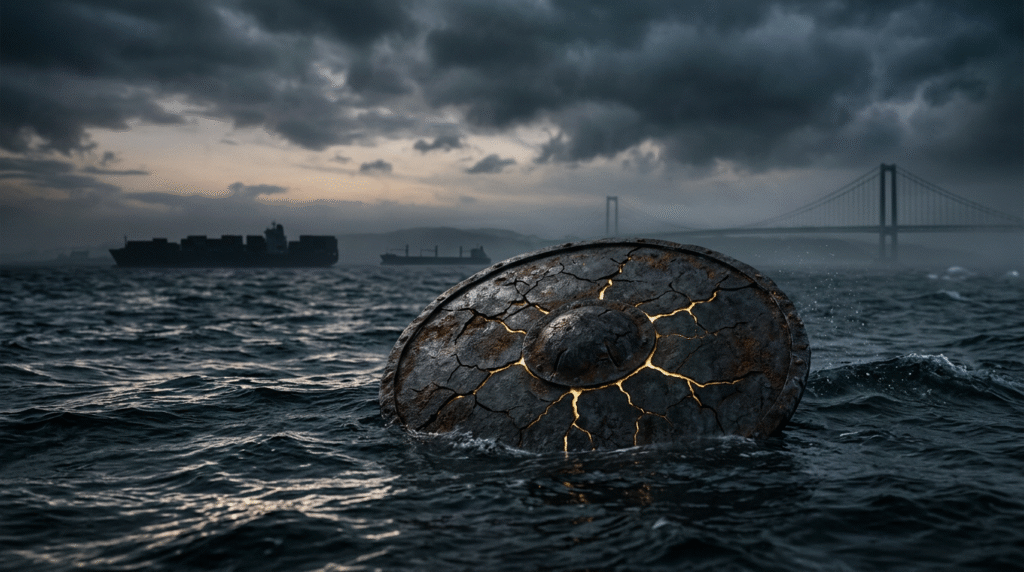
It exists for good reason. Without it, maritime commerce, already high-risk, capital-intensive, and international, would become nearly uninsurable. No owner would invest in ships if a single allision could mean unlimited personal ruin.
But in the past year, three separate legal developments arising from a catastrophic bridge collapse in the US and a wreck removal case in Australia have put real cracks in that shield. This article examines what happened, how they connect, and what they mean for ship owners, technical managers, and the future of the international limitation regime itself.
The US Bridge Collapse: Civil Side
The facts are widely known. A container ship leaving a major US port suffered successive power blackouts while still within the harbour approaches. It struck a main bridge support. The bridge collapsed. Six people died. A major port was effectively closed for months.
When the shipowner filed a limitation action under the 1851 Act, they sought to cap their total civil liability at around USD $45 million, the estimated post-casualty value of the vessel plus the freight it was carrying.
The state government pushed back hard. They alleged the vessel was unseaworthy at departure, that a non-approved component had been used in the fuel system serving the ship’s generators, that this was known to shore management, and that the vessel had experienced prior blackout incidents that were not properly reported. If proven, these facts would establish “privity or knowledge” on the part of the owner, defeating limitation entirely.
A trial on the limitation question was scheduled.
But weeks before that trial was due to start, the parties settled. Market reports suggest a settlement figure in the low billions, far exceeding any plausible limitation fund.
No court ruled on whether the 1851 Act would have applied. But settlement numbers of that magnitude do not emerge from a position of strength. The inference is clear: the evidence assembled by the claimants was sufficiently compelling that the owner and operator judged the risk of losing limitation entirely, and facing potentially billions more in un-capped damages, to be intolerable.
What this tells us: The 1851 Act is still on the books, but its protection is only as strong as the owner’s ability to prove they had no knowledge of the conditions that led to the casualty. When shoreside management is involved in technical decisions, approving modifications, responding to defect reports, deciding whether a vessel sails, that creates a paper trail. And that paper trail can defeat limitation.
The US Bridge Collapse: Criminal Side
Separately, federal prosecutors in the United States unsealed a criminal indictment against the ship’s operator and a shore-based technical superintendent.
The charges included conspiracy to defraud the United States, obstruction of an agency proceeding, making false statements to investigators, and willful failure to report a hazardous condition to the Coast Guard. The operator also faced environmental misdemeanours. The core allegation was that the non-approved fuel system configuration was known to shore management, that inspection records were allegedly falsified, and that investigators were subsequently misled.
This is a significant departure from the normal pattern after a marine casualty. Historically, even major casualties have been dealt with through civil proceedings, limitation fights, insurance claims, regulatory fines. Criminal prosecution of the operator and an individual superintendent elevates the stakes dramatically.
Why? Because criminal liability sits entirely outside the limitation framework. The 1851 Act and the LLMC 1976 cannot cap a criminal fine. P&I insurance does not cover criminal penalties. And when individuals are charged, not just the corporation, they face personal exposure that no corporate limitation fund can reach.
What this tells us: The line between operational negligence and criminal conduct is now being drawn in places it hasn’t been before. Allegations of concealment, falsification, or knowingly operating an unsafe vessel can move a case from the civil docket to the criminal one. For technical managers and superintendents, this is a personal risk that cannot be insured away.
The Australian Wreck Removal Case
On the other side of the world, a different kind of limitation challenge was playing out.
A bulk carrier allided with two moored tugs at a port in Tasmania, sinking both. The port authority incurred wreck removal and clean-up costs in the vicinity of A$17 million. The shipowner sought to limit liability under the LLMC 1976.
But Australia, like some other LLMC signatories, exercised its right under Article 18 of the Convention to reserve, meaning it opted out of, Articles 2(1)(d) and (e), which cover claims for the removal, destruction, or rendering harmless of a wrecked ship or its cargo.
The question was whether an owner could nonetheless access the limitation fund by characterising the wreck removal costs as “damage to property” under Article 2(1)(a) instead.
The answer, from Australia’s Full Federal Court in 2025 and confirmed by the High Court on appeal in 2026, was no. The courts held that the Article 18 reservation is substantive, not merely procedural. If the substance of the claim is wreck removal, it cannot be re-labelled to fit under another head of claim. Wreck removal costs in Australian waters are categorically non-limitable.
What this tells us: For any vessel trading to Australia, wreck removal exposure is uncapped, regardless of the owner’s conduct or whether they can prove absence of privity or knowledge. It is a strict, jurisdiction-specific carve-out from the LLMC regime. Port authorities and terminal operators in Australia now have a powerful tool that their counterparts in other countries may not.
The Common Thread
Three developments. Three different legal mechanisms. But the direction is the same.
| Mechanism | What happened |
| Privity/knowledge challenge under 1851 Act | Civil limitation defeated by settlement far above the claimed fund |
| Criminal prosecution outside limitation framework | Operator and individual charged; no limitation defence available |
| Statutory interpretation of LLMC Article 18 | Wreck removal claims held non-limitable in Australian courts |
In each case, the traditional protection was either bypassed, overwhelmed, or removed entirely. None of these developments abolishes limitation of liability as a concept. But together, they represent a meaningful narrowing of when and how it applies.
What This Means for Ship Owners and Technical Managers
How real is the risk?
Very real, particularly for mid-sized owners and technical management companies.
Consider the US bridge case: market reports point to a settlement in the low billions. For most mid-sized shipowning groups, exposures in that range would be balance-sheet threatening. A single casualty of this scale, if limitation is denied, could be a liquidation event.
Consider the Australian case: A$17 million in wreck removal costs, uncapped. For a bulk carrier trading to Australia, that exposure exists on every voyage. Multiply by a major casualty, a grounding, a collision, a wreck that blocks a port, and the numbers quickly exceed typical P&I policy limits for wreck removal.
The Goliath risk is not theoretical. It’s the law.
The privity or knowledge trap
The more involved shoreside management becomes in technical decision-making, the harder it is to later claim ignorance. Detailed email chains about equipment modifications. Approval of deviations from manufacturer specifications. Knowledge of recurring defects that weren’t resolved. All of this creates the kind of paper trail that defeats limitation under the 1851 Act, and may also support criminal allegations of knowing concealment.
This is a structural challenge for the technical management model. Management companies exist precisely because they provide expert oversight, but that oversight also creates visibility, and visibility creates potential liability.
What can be done?
Some practical steps:
Documentation discipline. Every modification, deviation, or workaround should be formally risk-assessed, approved through proper channels, and recorded. If a non-approved configuration exists on a vessel, the paper trail should show who decided, why, and what the risk assessment was. An undocumented shortcut is vastly more damaging in litigation than a documented, risk-assessed one, even if both are ultimately found to be non-compliant.
No shortcuts on class and statutory certifications. The allegations of falsified inspection records in the US case are a stark warning. When documents are alleged to have been manufactured after the fact to cover up a known issue, the case moves from negligence to fraud, and from civil to criminal.
Post-casualty discipline. How a company responds after a casualty is almost as important as how the vessel was operated beforehand. Concealment, delayed reporting, inconsistent statements to investigators, or document destruction can transform a manageable civil claim into a criminal indictment. The response should be transparent, prompt, and professionally advised.
Insurance review. Owners should understand exactly where their P&I cover stands on wreck removal in jurisdictions like Australia where limitation may not apply. They should also understand that criminal defence costs and penalties are typically excluded from standard cover.
Corporate structure. A single-ship company offers less protection than many assume if group management was directly involved in the operational decisions that led to the casualty. Courts and prosecutors increasingly look through corporate structures to the individuals who made the calls.
The real risk is not that limitation will be abolished tomorrow. It is that it will continue to be chipped away, case by case, jurisdiction by jurisdiction, while owners and managers do not realise their exposure has already changed.
What This Means for Policymakers and the IMO
The LLMC 1976 is a compromise instrument. It balances the interests of shipowners (who need predictable exposure) against the interests of cargo interests, ports, coastal states, and the public (who need adequate compensation when things go wrong). It works only as long as the major maritime jurisdictions apply it consistently.
Developments like the Australian Article 18 reservation, and the willingness of US prosecutors to pursue criminal charges that make limitation irrelevant, put pressure on that consensus.
Three questions for the IMO and member states:
First: Can the LLMC survive divergent interpretation? If major trading nations apply the convention in fundamentally different ways, and particularly if they remove whole categories of claims from the limitation regime, the predictability that makes the LLMC valuable begins to erode. Shipowners need to know their exposure before a voyage starts, not discover it after a casualty based on which court hears the case.
Second: Is the limitation level itself adequate? The numbers in the US bridge case highlight a mismatch: a 19th-century liability cap designed when ships were worth far less than the infrastructure they can destroy. The IMO’s periodic review of limitation levels under the LLMC already happens, but the gap between convention limits and actual potential damages in major casualties is widening. This fuels pressure from developing nations and coastal states to raise limits further or remove certain heads of claim entirely.
Third: What about autonomous ships? The pending MASS (Maritime Autonomous Surface Ships) Code will force the limitation question anyway. When there is no crew on board and decisions are made by shore-based operators, who is the “owner” for limitation purposes? Where does “privity or knowledge” sit when control is exercised remotely, potentially across multiple jurisdictions? The MASS Code cannot answer these questions alone, they will require revisiting the LLMC framework itself.
Hong Kong’s position matters. As a major shipping centre, a flag state, and a jurisdiction whose own limitation jurisprudence was cited in the Australian Goliath decision, Hong Kong has a voice in this conversation. The question for policymakers is whether to advocate for stability in the existing LLMC regime or to engage proactively in reform before the cracks become a break.
Closing Thoughts
Limitation of liability is not dead. The 1851 Act and the LLMC 1976 remain in force, and courts continue to apply them. But the developments of 2025-2026 are a warning that the protection is not as absolute as it once appeared.
For a Master Mariner reading this: the implications are practical, not abstract. The decisions made in the engine room and the superintendent’s office, what equipment configuration is approved, what defect reports are escalated, what gets documented and what doesn’t, all feed into the legal record that will determine whether limitation holds after a casualty.
The shield is still there. But it’s thinner than it used to be. And pretending otherwise is the surest way to find yourself on the wrong side of the crack.